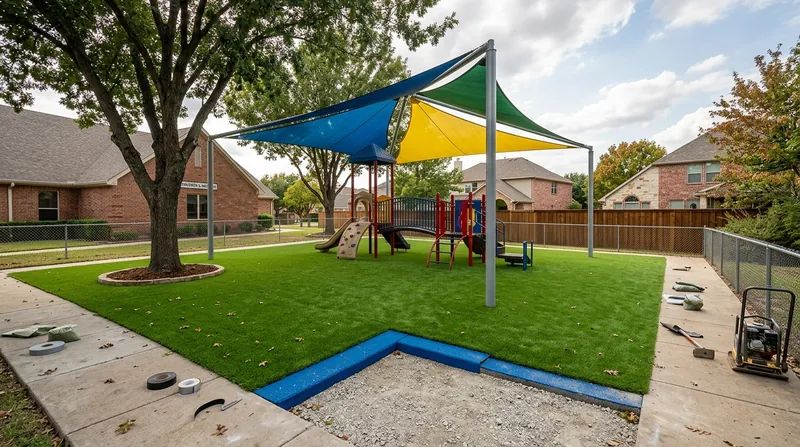




Playground & school turf in Fort Worth requires a surface built for impact, drainage, and year-round use in the Texas heat and clay soil that dominates the region. Schools, parks, and daycare centers across Fort Worth, Keller, Colleyville, and Southlake face the same problem: real grass dies under heavy foot traffic, irrigation costs climb in summer, and muddy patches create liability during spring storms. Synthetic turf solves that problem with a durable, low-maintenance playing surface that stands up to 100-degree heat, handles drainage on Blackland clay, and meets safety fall-height standards. Fort Worth Turf Installation has installed playground and school turf since 2013, working with district facilities managers, HOAs managing common areas, and private schools to build surfaces that last through decades of use. We size the infill, specify the pile height for safety compliance, and manage drainage so water moves through the turf and away from the base, not into the clay.
Why Playground & School Turf Matters in Fort Worth's Hot, High-Traffic Environment
Real grass cannot handle the combination of Fort Worth's summer heat, heavy use, and clay soil. Children and staff put down foot traffic that compacts earth and kills turf roots. Spring storms dump rain that pools on clay instead of draining. The cost to maintain a real grass playground includes weekly mowing in season, frequent overseeding, fungicide applications, and irrigation that runs thousands of gallons a month. Synthetic turf eliminates that cycle and gives schools and parks a surface that drains, resists wear, and stays playable year-round without herbicide or fertilizer applications.
- We install turf that meets ASTM F1292 fall-height standards for playground safety, with infill depth and pile height engineered for impact protection.
- Drainage is built into the base so water moves through the turf and into the subgrade, not pooling on clay soil after rain.
- Antimicrobial infill options reduce odor and bacterial growth in high-use areas like dog parks and school play yards.
- The surface withstands Fort Worth's 100-plus degree summer days without the heat buildup that unshaded artificial turf can develop in direct sun.
- Installation includes edging and perimeter work so the turf stays in place under heavy traffic and does not migrate toward buildings or walkways.
A properly built playground or school turf surface removes the maintenance burden and creates a safe, durable play area for years.
Key info: Fort Worth Independent School District, Keller ISD, and private schools across the metroplex are moving to synthetic turf for athletic fields and play yards. We work with facility managers to navigate specifications, drainage requirements, and budget constraints so the turf meets district standards and survives the Texas climate.
For technical guidance on playground turf standards, the ASTM F1292 standard sets fall-height and impact attenuation requirements for synthetic surfaces in playgrounds and schools across the United States.
How We Install Playground & School Turf: Our Process in Fort Worth
Playground and school turf installation begins with site assessment and drainage planning. We locate utilities, establish base depth requirements, and plan the infill type and volume so the surface meets fall-height standards and drains properly on Fort Worth's clay soil. The installation sequence is straightforward but precise: we remove existing turf or bare ground, grade the site, install a geotextile or drainage layer, lay the turf in seams we tape and glue, and apply infill in calculated pounds per square foot. The entire process takes two to five days depending on yard size and complexity. We use the same installation discipline on a 2,000-square-foot school play yard as on a residential pet turf project, because safety and drainage do not scale down.
- We request a Texas 811 utility locate before excavation so we do not cut into water, gas, electric, or fiber lines buried under the play yard.
- We grade the site to slope gently so water does not pond, then lay geotextile and a drainage base at two to four inches depth depending on soil conditions and infill type.
- We unroll the turf, position it to minimize seams in high-traffic zones, tape and glue seams using turf-grade adhesive, and trim edges to fit walkways, buildings, and fencing.
- We broadcast infill evenly across the turf, working it down into the pile with a drag brush so it settles at the correct depth for fall-height compliance and drainage.
- We inspect the entire surface for seam integrity, infill distribution, and proper edge anchoring before the school or park takes possession.
The result is a finished playground surface ready for immediate use, with no curing time or settling period.
Example: A Keller elementary school play yard measured 3,200 square feet with compacted clay and poor drainage. We removed the dead grass, installed a four-inch gravel and geotextile base, laid 50-ounce playground turf with antimicrobial zeolite infill, and finished in three days. The surface now handles spring rain without pooling and withstands daily recess traffic without wear.
For detailed pricing and to understand how your specific site affects installation cost, visit our pricing page or call (682) 354-9527 for a free estimate.
| Installation Approach | Description | Best For |
|---|---|---|
| New installation on bare ground or dead turf | Remove existing material, grade, install base, lay turf, apply infill. Complete surface replacement. | Schools, parks, and daycare yards starting from scratch or replacing failed real grass. |
| Partial replacement or repair | Install turf over a section of the play yard, seaming to existing turf. Useful when budget requires phased work. | Expanding an existing synthetic surface or replacing a worn zone while keeping the rest of the yard in service. |
| Over-existing-turf installation | Lay new turf directly over old turf if the base is sound and drainage is adequate. Fastest method, lowest labor. | Replacing worn playground turf when the underlying base has not failed and water moves through correctly. |
| Full base rebuild with new infill system | Remove turf and base, excavate, install new gravel, geotextile, and drainage layer, lay new turf, apply new infill type (e.g., switching to antimicrobial zeolite). | Playgrounds with drainage failure, contaminated soil, or changing safety or performance requirements. |
Playground & School Turf Cost in Fort Worth: What to Expect
Playground and school turf pricing in Fort Worth starts at $10 per square foot for new installation on prepared ground, including turf, infill, and labor. A 3,000-square-foot school play yard typically runs $30,000 to $45,000 depending on site conditions, infill type, and whether the base needs excavation or regrading. Larger projects, such as athletic fields or multi-zone playgrounds, are quoted on-site because drainage, soil conditions, utility conflicts, and access all affect the final cost. Antimicrobial infill (zeolite or engineered products) adds $1 to $3 per square foot. Partial repairs or seam work cost less and are priced by the square foot or the hour depending on scope.
The biggest cost drivers are soil condition (clay requires more base prep than sandy soil), existing drainage problems (which must be fixed before turf goes down), and whether the site has utility lines or tree roots that complicate excavation. A site with poor drainage on Blackland clay will cost more to prepare than one with sandy soil and good water movement. We always recommend getting two or three estimates so you can compare approach, material choices, and timeline alongside price.
Visit our full pricing guide for cost breakdowns by project type and to understand what factors move the price in your area. Call (682) 354-9527 for a free, no-obligation estimate on your specific playground or school yard.
Playground & School Turf Near Me: What Fort Worth Homeowners and Facility Managers Should Know When Hiring
Hiring a turf installation company for a playground or school project means verifying that the installer understands fall-height standards, drainage design, and the infill types that make synthetic turf safe for children. Ask for a certificate of insurance showing general liability and workers' compensation coverage. Request a written specification that names the turf product, face weight, pile height, infill type and pounds per square foot, base depth, and compaction method. Check references and ask to see photos of finished playgrounds or school yards. Many itinerant crews lay turf on bare dirt and leave, which fails on clay soil and does not meet safety standards. An independent turf installation company should explain how the base and infill work together to provide drainage and impact protection, not just quote a price per square foot.
If the project sits on school district property, ask about any district specifications or standards the turf must meet. Some districts require ASTM F1292 certification for fall-height or mandate certain infill types. If the yard is in an HOA-governed community, verify that synthetic turf is allowed and what color or pile restrictions apply. Permits for turf itself are rarely required, but grading that changes drainage or work in a utility right-of-way may trigger city or county permits, so confirm with the local building department before work begins.
Fort Worth Turf Installation has worked with schools, parks, and private facilities across Fort Worth, Keller, Colleyville, and Southlake since 2013. We are fully insured and provide written specs for every job. Contact us for a free estimate and to discuss your playground or school turf project.
Playground & School Turf in Fort Worth: Pricing Guide
| Service | Price | Details |
|---|---|---|
| New playground turf installation | Starting at $10/sq ft | Includes turf, standard infill, labor, and base prep on prepared or cleared ground in Fort Worth area |
| Antimicrobial or premium infill upgrade | Add $1 to $3/sq ft | Zeolite, engineered antimicrobial, or cooling infill options increase cost based on product type and performance |
| Base excavation and drainage repair | On estimate | Poor drainage on clay soil or existing turf removal requires site assessment to determine depth and regrading cost |
| Seam repair or partial turf replacement | On estimate | Localized wear or seam separation priced by square footage and complexity of the existing turf condition |
| Travel and site visit | Included | No separate mileage or travel fee for Fort Worth and surrounding service areas within 30 miles |
| Free estimate | No charge | Response within 24 hours at (682) 354-9527, includes site walk, drainage assessment, and written proposal |
Indicative pricing, the exact cost depends on square footage, finish, and site access. Free personalized estimate within 24h at (682) 354-9527.


